
UC Summer School in the Philippines with ASEAN Partner Universities
2025.10.14
The Southeast Asian Ministers of Education Organization – Southeast Asian Regional Center for Graduate Study and Research in Agriculture (SEAMEO-SEARCA), through its University Consortium (UC), organizes an annual Summer School program across the Southeast Asian region. This year, students from the University of Tsukuba participated for the first time through the Multicultural Campus Project Toward Social Impact. The activity is hosted at Central Luzon State University, with students from Kasetsart University, Maejo University, National Taiwan University, Universitas Gadjah Mada, Universiti Putra Malaysia, University of the Philippines Los Baños, Universitas Brawijaya, Tokyo University of Agriculture, Central Mindanao University, and Visayas State University. The students joined the program as part of their field immersion practice under the Appropriate Technology class, where they conduct field research to identify local issues and develop context-appropriate solutions that aim to improve the quality of life in the communities they work with. The theme of this year’s program was “Ridge to Reef: Integrated Management for Sustainable and Resilient Food Systems.”
Before the field activities (July 21–26), students attended a series of online lectures on Ridge-to-Reef Resource Management. The lectures covered topics such as (1) Community-Based Forest Management, (2) Environmental Degradation and Dinoflagellates, (3) Community-Based Coastal Ecosystem Management, and (4) the Ridge-to-Reef Program in the Philippines.

During the first week of activities in the Philippines (July 27–August 3), students conducted on-campus resource management assessments, including biodiversity surveys, land use assessments, and waste management evaluations. In the second week (August 4–7), they applied these methods on San Salvador Island, Zambales. Based on their field research and interviews with local residents, the students developed proposals for a Ridge-to-Reef Management Plan, which they presented to local residents, experts, and government officials.

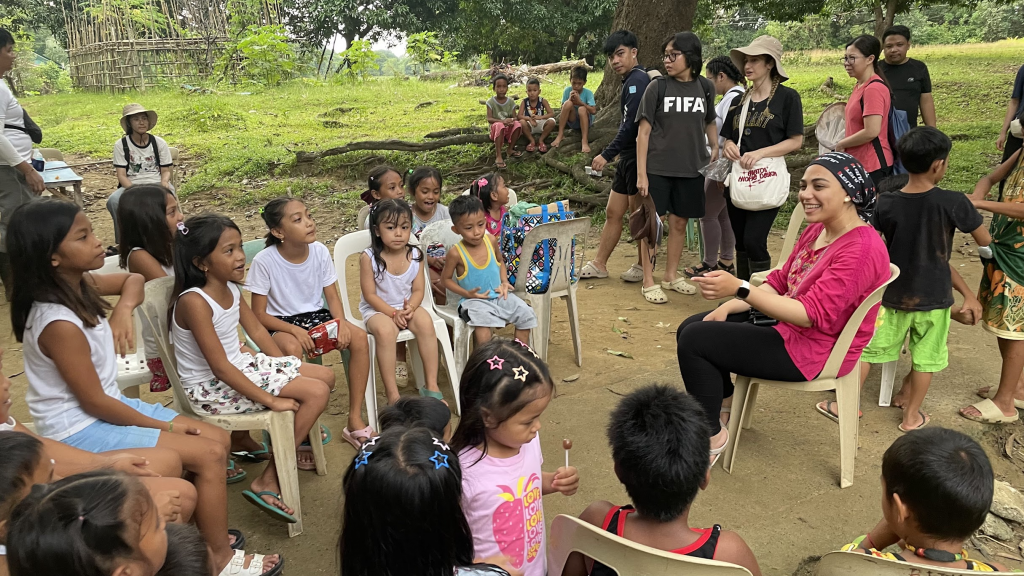
Despite their diverse academic backgrounds, the students adapted well to team activities and remained eager to learn, even when their prior knowledge of environmental sustainability was limited. During their stay, they experienced power outages caused by inclement weather, which provided valuable hands-on learning experiences. They also participated in coastal cleanup activities, contributing to the preservation of the local environment.


The students engaged in lively interdisciplinary discussions and demonstrated a high level of learning. Furthermore, their proposals will be utilized by the local government in formulating future management policies.

Student Report:
Nao Hosomi (細見 奈生)
Human Biology Program, University of Tsukuba (2nd year)
Introduction
From July 28 to August 8, 2025, I participated in the “9th UC Summer School” based at Central Luzon State University (CLSU), Philippines. The program was organized by the University Consortium for Southeast Asia (UC) and focused on the central theme of “Ridge-to-Reef” integrated resource management and food security. The program included lectures, fieldwork, a homestay on a remote Philippine island with a population of about 2,000, and a presentation of the final results during the program.
Summary of Activities
Lectures and Workshops
From the first day, lectures on “Integrated Pest Management,” “Land Use Assessment,” and “Ridge to Reef Integrated Management” provided basic knowledge on agroecosystem and environmental management. Based on these contents, participants developed perspectives on applying theories to the field through concept mapping and discussion in groups.

Biodiversity Survey
From July 30 to August 1, the group conducted a biodiversity survey of plants, animals, and insects in a natural park within CLSU. Our team collected data by ourselves and reported and presented the results of the analysis using the Shannon and Simpson indices for each group. Although the project required knowledge that was different from my own major field of study at the graduate school, I was able to deepen my understanding of analytical methods even outside my field of expertise.
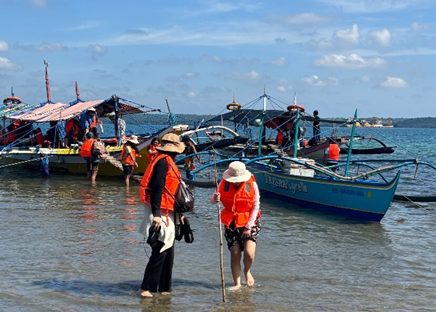
Fieldwork on the island of San Salvador
From August 4 to 7, homestay and fieldwork were conducted on the island of Masinloc San Salvador (population of about 2,000, 20 minutes by boat from the mainland). In addition to the biodiversity survey learned in the CLSU on the mainland, interviews and observations with local residents were conducted to investigate the current state of agriculture and fisheries, waste management issues, and the destabilization of livelihoods due to climate change. As a result, inadequate waste management and declining agricultural productivity were identified as serious issues directly related to food security in the region.
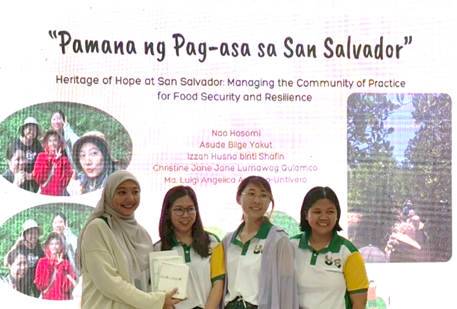
Presentation of final results
On the final day (August 8), each group presented its “Ridge-to-Reef-based Community Resource Management Plan”. My group presented a community-driven proposal on waste management, agricultural productivity improvement, marine conservation, and climate change adaptation under the theme “Pamana ng Pag-asa sa San Salvador” (Heritage of Hope at San Salvador). The presentation integrated the results of quantitative biodiversity analysis and the voices of local residents to present practical and sustainable solutions. For this, the presentation received the Best Presentation Award.
Discussion and Impressions
By participating in this program, I was able to gain a different perspective from my traditional research field. Although I usually conduct research mainly on animal experiments in medical and life science laboratories, this program allowed me to come into contact with issues with a broader and more social context, such as ecosystem assessment and resource management in local communities. Through this experience, I recognized once again that multifaceted perspectives are indispensable in returning research results to society.
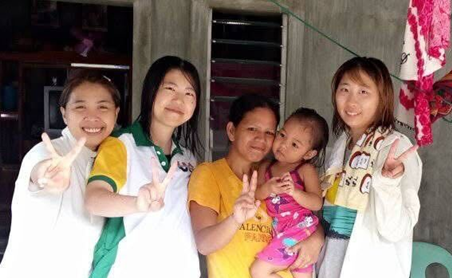
The homestay experience on the island was also a deeply memorable experience in terms of both academic activities and living experience. The island lacks basic infrastructure such as electricity and running water, and for the four days we were there, the island was left without power due to a broken power cable from the mainland. Despite this environment, the residents never stopped smiling and warmly welcomed us, our families, the community, and even us. This was different from the flow of time and sense of values in urban life, and it left a strong impression on me. The way these people live with limited resources while caring for each other reminded me of the importance of fundamental values such as the environment, life, and family, and I strongly felt the need to be aware of these values in my own research activities.

Conclusion
The 9th UC Summer School was a learning experience that embodied the “integration of theory and practice” through lectures and fieldwork. In particular, the research and living experience on the island of San Salvador deepened my understanding of food security and environmental issues, and at the same time, provided an opportunity to reconsider my own attitude as a researcher.
Finally, we would like to express our deepest gratitude to all those involved in planning and organizing this program. We would also like to express our sincere gratitude to Dr. Irie and Dr. Arvin for their willingness to support our participation in this program.
Program Highlights